17, 18 June 2026
Location: Battelle, building B, room B2.21
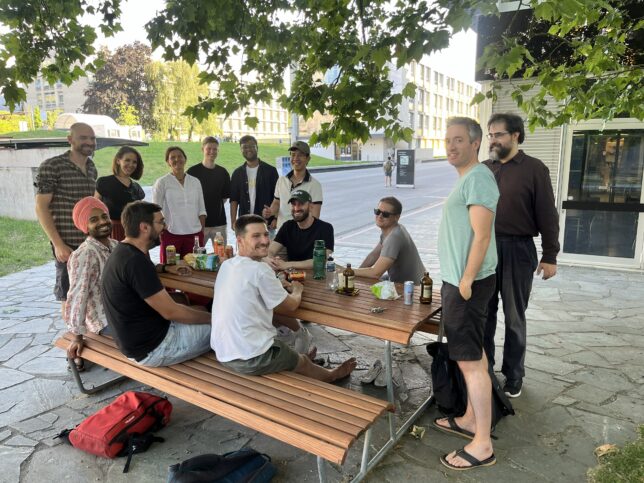
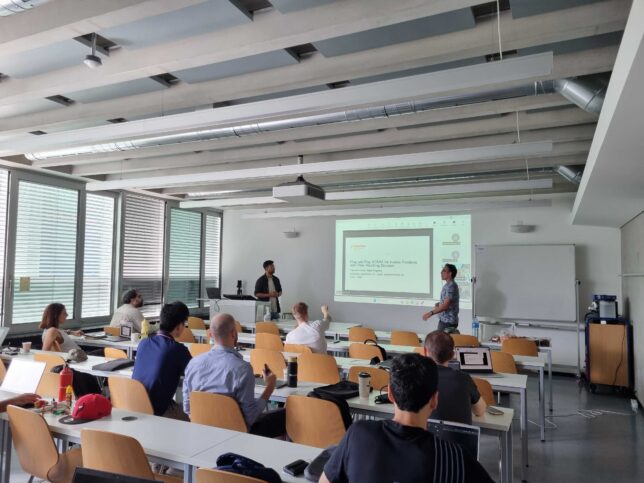
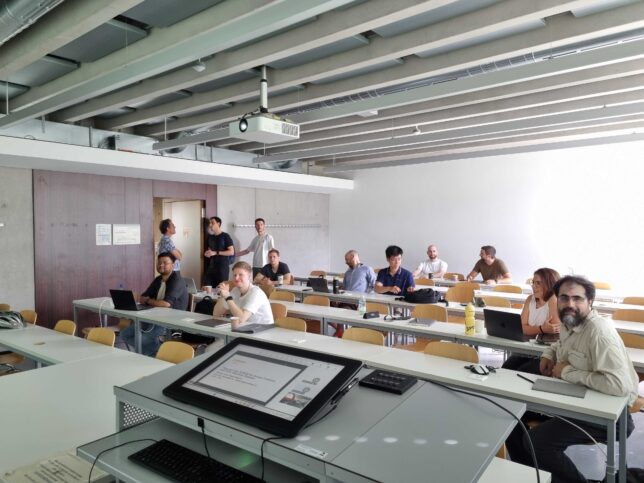
That’s a wrap on the third edition of our Summer ML Workshop! Hosted by our DMML group at HEG Geneva, we were absolutely thrilled to welcome Prof. Magda Gregorova and her Probabilistic Deep Learning Group (PDLG) of CAIRO.thws group for two days of fantastic science. We ditched the formalities for a relaxed, open atmosphere where we could just gather, share ideas, and talk freely about the research we are passionate about. The program featured 15 excellent talks, including a great invited presentation by Thibault Vatter (HEG Geneva), that sparked endless coffee-break debates and collaborative brainstorming. Whether we were diving into diffusion, flows, and guidance, or unpacking inverse models, posterior inference, physics-informed ML, and discrete structures, the rich mix of topics triggered lively, inspiring discussions from start to finish. It was exactly what a summer workshop should be: great people, open minds, and plenty of discussions about the future of machine learning!
Wednesday 17/6
Section: Generative Models
| 10:00–10:30 | Dibyanshu Kumar | Work under peer review, will be released upon acceptance | ||
| 10:30–11:00 | Frantzeska Lavda | Where to Inject Noise: Spatially Adaptive Sampling for Diffusion Models | Diffusion probabilistic models achieve state-of-the-art generation quality, but current samplers, whether stochastic or deterministic, apply spatially uniform noise that ignores the heterogeneous geometry of data manifolds. Every pixel receives identical stochasticity despite the fact that high-curvature regions such as edges and textures benefit from stochastic exploration, while flat regions like uniform backgrounds are harmed by unnecessary noise. We propose Spatially Adaptive Noise Injection (SANI), a sampling framework that modulates stochasticity pixel by pixel. The method uses uncertainty estimates derived from local score geometry and posterior covariance and interpolates between deterministic and stochastic dynamics depending on local confidence. |
PhD Oral Exam
| 11:00–12:15 | Philipp Väth | Training-Free Guidance in Diffusion Models: From Classifier Gradients to Future Control Mechanisms | Training-free inverse modeling and guidance in diffusion models both tackle the core challenge of sampling from complex posteriors using pre-trained likelihood and prior models, typically under different task settings but with closely related mechanisms. This presentation aims to unify these perspectives and to position the first half of my PhD within this broader landscape. So far, my work has focused on classifier-based guidance under realistic plug-and-play constraints. GradCheck systematically analyzes classifier guidance gradients during conditional diffusion sampling and reveals failure modes such as conflicting and highly unstable gradients that are invisible from sample quality alone. Building on this analysis, nr-CG applies techniques from stochastic optimization to stabilize the guidance signal, enabling the use of non-robust classifiers trained without explicit noise augmentation. Finally, XAIDIFF leverages stabilized classifier gradients for generating counterfactual explanations. Future work focuses on combining training-free guidance and inverse modeling, developing a unified theoretical understanding of training-free guidance as approximate posterior sampling, and identifying failure cases for very complex likelihood models. |
Lunch break
12:30–14:00
Section: Generative Models
| 14:00–14:30 | Yoann Boget | Rethink Simplex Flow Matching | Adapting denoising models for discrete data generation represents a challenging and thriving area of research. Simplex-based approaches offer a compelling framework for addressing this problem, yet they introduce inherent challenges and dilemmas. To overcome these, we propose a reframing of the classical flow matching framework, enabling more principled and effective discrete generation. We validate our approaches through experimental results in chemistry and biology, demonstrating practical effectiveness. | |
| 14:30–15:00 | Van Khoa Nguyen | Work under peer review, will be released upon acceptance | ||
| 15:00–15:30 | Pablo Strasser | Compression-Driven Decoder-Only Distribution Learning on Manifolds with Latent Local Model | We propose a framework for learning probability distributions on data manifolds using a decoder-only model, where global structure emerges from the implicit combination of local latent models. The model defines a prior over discrete latent variables and a conditional distribution over pixels, without requiring an encoder at inference time. Compression and generative modeling are tightly connected, as optimal compression corresponds to accurate probabilistic modeling of the data distribution. Training is driven by a compression objective consisting of latent code length and conditional cross-entropy. Each sample is represented through a set of latent-conditioned local distributions that combine implicitly into a coherent global model. The approach connects decoder-only modeling with manifold learning, sparse representations, and compositional function approximation. |
Coffee break
15:30–16:00
Section: RL
| 16:00–16:30 | Hugues Vinzent | Work under peer review, will be released upon acceptance | ||
| 16:00–16:30 | Lionel Blonde | Work under peer review, will be released upon acceptance | ||
| 16:30–17:00 | Jacopo Castellini | Lenient Multi-Agent Policy Gradients | Multi-agent policy gradient methods have achieved major advances in solving complex tasks, particularly through centralized training and decentralized execution. However, coordination pathologies such as relative overgeneralization remain challenging. This work introduces Lenient Multi-Agent Policy Gradients (LMAPG), combining leniency, an optimistic approach that handles stochastic rewards, with the centralized training-decentralized execution paradigm. The resulting formulation applies to both policy gradient and policy optimization methods and can be integrated into existing algorithms with minimal additional computational cost. |
Thursday 17/6
Invited Talk
| 09:30–10:15 | Thibault Vatter | Throwing Vines at the Wall: Structure Learning via Random Search | Vine copulas provide flexible multivariate dependence modeling and have become widely used in machine learning. However, structure learning remains a major challenge. While Dissmann’s greedy algorithm remains the standard approach, it is often suboptimal. This work proposes random search algorithms together with a statistical framework based on model confidence sets to improve structure selection. The framework provides theoretical guarantees on selection probabilities and excess risk and serves as a foundation for ensembling. Experiments on real-world datasets consistently outperform state-of-the-art methods. |
Coffee break
10:15–10:45
Section: ML & Science
| 10:45–11:15 | Gurjeet Singh | Work under peer review, will be released upon acceptance |
| 11:15–11:45 | Joao Candido Ramos | Work under peer review, will be released upon acceptance |
Lunch break
11:45–14:00
Section: ML & Science
| 14:00–14:30 | Malik Marco Algelly | Forecasting and Root-Cause Analysis of Drifting Accelerator Systems with Continual Learning | Particle accelerators are complex systems whose components age and drift, causing models trained on past behavior to become outdated. Using the PS extraction kicker (KFA71) at CERN as a case study, this work explores machine learning methods for forecasting and root-cause analysis. A conditional variational autoencoder learns normal system behavior to identify deviations before faults occur, while a neural surrogate of a SPICE simulation enables Bayesian inference to identify which physical parameters have changed. Continual learning techniques are investigated to keep forecasting models current without requiring complete retraining. | |
| 14:30–15:00 | Nils Schaetti | Generative Posterior Inference for Seismic Inversion under Model Misspecification | Seismic inversion is essential for subsurface characterization, with applications in geothermal exploration, hazard assessment, and environmental monitoring. This talk presents generative posterior inference for trans-dimensional seismic inversion, comparing normalizing flows and conditional flow matching with traditional MCMC-based approaches. A central challenge is model misspecification in simulation-based inference. The discussion focuses on diagnosing discrepancies between simulations and real observations, mapping plausible solution spaces, and bridging synthetic and real data using broader priors, explicit error models, and adaptive calibration based on robust statistics. | |
| 15:00–15:30 | Giangiacommo Mercatali | Work under peer review, will be released upon acceptance |